Sam Walton Biography: How the Walmart Founder Built a Global Retail Empire
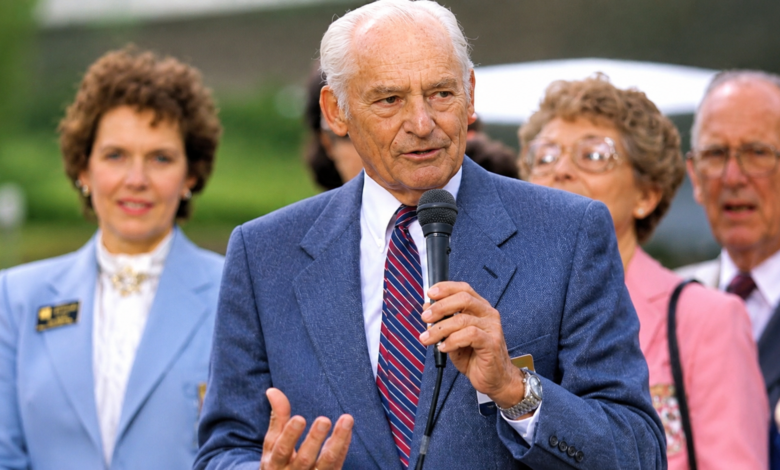
Explore the complete Sam Walton biography—from his early Ben Franklin store in Arkansas and founding Walmart in 1962 to launching Sam’s Club, building a $25 billion fortune, and transforming global retail.
With a folksy, pickup-driving demeanor and an obsession with everyday low prices, Sam Walton transformed a single small-town variety store into Walmart, the largest retailer on Earth. While established urban giants like Sears, Kmart, and Woolworth’s overlooked small rural towns, Walton quietly built an operational powerhouse that shifted the balance of retail power permanently toward the consumer—making himself the richest person in America in the process.
Sam Walton Quick Profile
| Attribute | Details |
| Full Name | Samuel Moore Walton |
| Born | March 29, 1918 · Kingfisher, Oklahoma |
| Died | April 5, 1992 (Age 74) · Little Rock, Arkansas |
| Education | Hickman High School; University of Missouri |
| Military Service | U.S. Army Intelligence Corps (WWII Communications Officer, 1942–1945) |
| Spouse | Helen Robson Walton |
| Children | Rob, John (d. 2005), Jim, and Alice Walton |
| Key Companies Founded | Walmart (1962) & Sam’s Club (1983) |
| Net Worth at Passing | ~$25 Billion (1992) |
Early Life, J.C. Penney Sales Floor, and WWII Service
Born in Oklahoma to Thomas Gibson Walton and Nancy Lee, Samuel Moore Walton grew up on a farm during the Great Depression, learning the value of frugality early. After graduating from Hickman High School and earning his degree from the University of Missouri, he entered retail in 1940 as a sales trainee at a J.C. Penney store in Des Moines, Iowa.
Walton struggled with tedious bookkeeping—hating to keep customers waiting while he balanced ledgers—and his manager nearly fired him for messy paperwork. What saved his job was raw salesmanship: Walton consistently earned roughly $25 extra per month in sales commissions on top of his starting salary.
Drafted into the U.S. Army in 1942, Walton served stateside as a communications officer in the Army Intelligence Corps during World War II. Returning to civilian life in 1945 with his wife Helen and a young family to support, the 27-year-old entrepreneur pooled $5,000 of his own savings with a $20,000 loan from his father-in-law to purchase a Ben Franklin variety store franchise in Newport, Arkansas.
From Ben Franklin to Bentonville: The Birth of Walmart
By pricing merchandise consistently below competitors and focusing on high sales volume, Walton tripled the Newport store’s revenue within five years—making it the top-performing Ben Franklin store across a six-state region by 1950. His success proved too tempting for his landlord, who refused to renew Walton’s lease so he could take over the store for his own son.
Refusing to quit, Walton relocated to the tiny town of Bentonville, Arkansas, secured a rock-solid 99-year lease on the town square, and opened Walton’s Five & Dime in the summer of 1950.
How Walton Scaled From 15 Variety Stores to Discount Pioneer
-
1950s Expansion: Reinvesting store profits and borrowed capital, Walton expanded across small towns, owning 15 variety stores by 1960.
-
The Big-Box Rural Discount Breakthrough: Dissatisfied with modest profit margins, Walton proposed building large-format stores in rural towns that discounted every item rather than just select specials. When Ben Franklin executives rejected his plan to halve wholesale margins, Walton mortgaged his home, borrowed heavily, and partnered with his brother Bud Walton to open the very first Wal-Mart Discount City in Rogers, Arkansas, in 1962.
-
Flying Under the Radar: Although Kmart (launched by S.S. Kresge) and Woolco (launched by Woolworth’s) debuted that same year, both focused on major metropolitan markets—leaving rural America wide open for Walton.
Going Public, Sam’s Club, and Retail Dominance
By 1969, Walton operated 18 Walmart stores across Arkansas and Missouri. To pay off debt and accelerate expansion without relying solely on bank loans, he took Walmart public in 1970—raising nearly $5 million while retaining 61% ownership for the Walton family.
| Year / Era | Major Milestone |
| 1970 | Walmart completes its Initial Public Offering (IPO), raising ~$5 million to fuel rapid store rollouts. |
| 1980 | Store count reaches 276 locations, soon expanding at roughly 100 new stores per year. |
| 1983 | Launches the first Sam’s Club warehouse store, targeting small-business owners and bulk shoppers. |
| 1985 | Forbes names Sam Walton the richest man in America with an estimated net worth of $2.8 billion. |
| 1987–1988 | Walmart becomes the 3rd-largest U.S. retailer; Walton hands CEO duties to David Glass (remaining Chairman) and opens the first Walmart Supercenter combining general merchandise with a full supermarket. |
| 1990–1992 | Despite a bone cancer diagnosis, Walton predicts $125B in annual revenue within a decade as Walmart overtakes Kmart and Sears to become America’s #1 retailer. |
Presidential Medal of Freedom, Legacy, and the Walton Family
On March 17, 1992, President George H.W. Bush awarded Sam Walton the Presidential Medal of Freedom, honoring his entrepreneurial drive and commitment to employees and rural communities. Just weeks later, Walton passed away on April 5, 1992, at the University of Arkansas Hospital, six days after his 74th birthday, leaving behind an estimated $25 billion fortune. Soon after, the University of Arkansas named its business school the Sam M. Walton College of Business.
Like Henry Ford’s assembly line, Walton’s logistics-driven discounting model permanently reshaped American commerce—paving the way for modern “category killer” retailers and putting everyday value at the center of retail.
Walmart and the Walton Family in the Modern Era
Decades after its small-town founding, Walmart grew into a global colossus generating $524 billion in annual revenue (fiscal year ended January 2020) across 11,766 stores with 2.2 million employees worldwide and $38 billion in projected e-commerce sales—even as modern inflationary pressures occasionally rattled Wall Street (including an 11% stock drop in May 2022 that wiped $19 billion off the family’s paper wealth). Today, Walton’s surviving children—Jim, Rob, and Alice Walton—along with daughter-in-law Christy and grandson Lukas (following the passing of son John Walton) retain nearly half ownership of Walmart through Walton Enterprises and continue steering the Walton Family Foundation.
Frequently Asked Questions
When and where did Sam Walton open the first Walmart?
Sam Walton opened the first Wal-Mart Discount City alongside his brother Bud Walton in Rogers, Arkansas, in 1962, after operating Walton’s Five & Dime in nearby Bentonville since 1950.
What was Sam Walton’s net worth when he died?
When Sam Walton passed away on April 5, 1992, at age 74, his net worth was estimated at nearly $25 billion—after having been named the richest man in America by Forbes in 1985.
Who owns Walmart today?
Roughly half of Walmart remains owned by the Walton family—led by Sam Walton’s children Jim, Rob, and Alice Walton, alongside Christy and Lukas Walton—through Walton Enterprises and individual family holdings.