Anthropic Researcher Claims to Solve the Riemann Hypothesis With Help From Claude AI
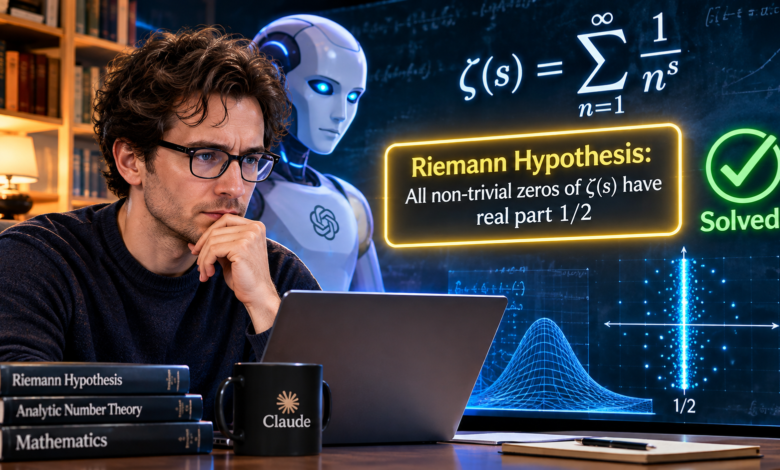
Anthropic mathematician Levent Alpöge claims he and AI assistant Claude found a formal Lean code proof of the 167-year-old Riemann Hypothesis—just one day after Anthropic’s historic $81B IPO
Anthropic Worker Claims to Have Solved a Holy Grail of Math Problems With the Help of AI
A mathematician on the technical staff at artificial intelligence powerhouse Anthropic has claimed a breakthrough on one of mathematics’ most famous unsolved mysteries—the Riemann Hypothesis—with substantial help from the company’s AI model, Claude.
Levent Alpöge announced the claimed proof on Friday in a four-page summary published on his personal website, releasing a massive formal verification package written in Lean code. The announcement marks the second time in recent months that an AI lab or affiliated researcher has claimed a solution to a Millennium Prize Problem, following OpenAI’s September announcement regarding the Navier-Stokes equations.
A 150-Year-Old Mystery Meets Modern AI
First formulated in 1859, the Riemann Hypothesis examines the underlying pattern and distribution of prime numbers—numbers divisible only by one and themselves—as they extend toward infinity. Solving it has eluded mathematicians for over a century and a half, earning it a place among the seven Millennium Prize Problems established by the Clay Mathematics Institute in 2000, each carrying a $1 million reward.
According to Alpöge, the decisive breakthrough came late Sunday night after months of intensive collaboration with Claude AI:
“Claude and I have had a great time together with such breadth in recent months, but this time Claude far outpaced me near the finish line. No, Claude flew, and danced, and sparkled near that finish line.”
Alpöge noted that he messaged Anthropic CEO Dario Amodei shortly after the discovery to ask about timing his announcement, as the San Francisco-based AI company was preparing for its historic stock market debut. One day after Anthropic went public on the Nasdaq—raising a record-breaking $81 billion at a $1.5 trillion valuation—Alpöge shared the proof publicly.
How the Proof Was Built: 17 Million Lines of Lean Code
Rather than releasing a traditional, human-written journal manuscript first, Alpöge published the argument inside 17 million lines of Lean code—a specialized programming language and interactive theorem prover designed to verify mathematical logic step by step. He noted that his broader AI-assisted research generated more than 250,000 pages of mathematical output, acknowledging that he is “presenting the world with a complete argument before having mastered a massive neighbourhood around its mathematics.”
How Mathematicians and the Clay Institute Are Responding
Rutgers University distinguished professor and mathematics department chair Alex Kontorovich explained why formal computer verification carries real weight—even before mathematicians fully digest the human intuition behind the proof.
-
Computer Precision: “Does that mean I understand it? Not yet. But the computer is extraordinarily picky, way pickier than I am and so if you can satisfy the computer, there’s a very, very good chance you’re going to satisfy me too,” Kontorovich said, adding that human mathematicians still have to put in the work to understand why the proof holds.
-
A Defining Moment for AI in Math: Reflecting on back-to-back claims involving major unsolved equations, Kontorovich remarked, “Navier-Stokes fell and now the Riemann Hypothesis. There’s some kind of out-of-body experience where I’m looking at myself saying, ‘Yes, the Riemann Hypothesis has been solved.’”
Meanwhile, Martin Bridson, president of the Clay Mathematics Institute, noted that rigorous verification takes considerable time before any official status changes or prize money is awarded:
“This is an announcement of historic significance, which holds the promise of a dramatic transformation in the perception of what is possible in the struggle to extend the human understanding of mathematics. But the journey from today’s announcement to a place of real understanding will be long and difficult.”
Frequently Asked Questions
Who claimed to solve the Riemann Hypothesis using AI?
Levent Alpöge, a mathematician and member of the technical staff at Anthropic, announced that he found a proof of the Riemann Hypothesis by collaborating with Anthropic’s AI assistant, Claude.
What is the Riemann Hypothesis and why is it important?
Proposed in 1859, the Riemann Hypothesis deals with the distribution of prime numbers. It is one of the seven Millennium Prize Problems selected by the Clay Mathematics Institute in 2000, carrying a $1 million prize for a verified solution.
Has the Riemann Hypothesis proof been officially verified yet?
While the proof passed automated checking inside 17 million lines of Lean code, the Clay Mathematics Institute still lists the problem as unsolved while mathematicians conduct the lengthy process of reviewing and understanding the argument.