Experts Warn AI-Generated Documents Can Weaken Brand Trust and Credibility
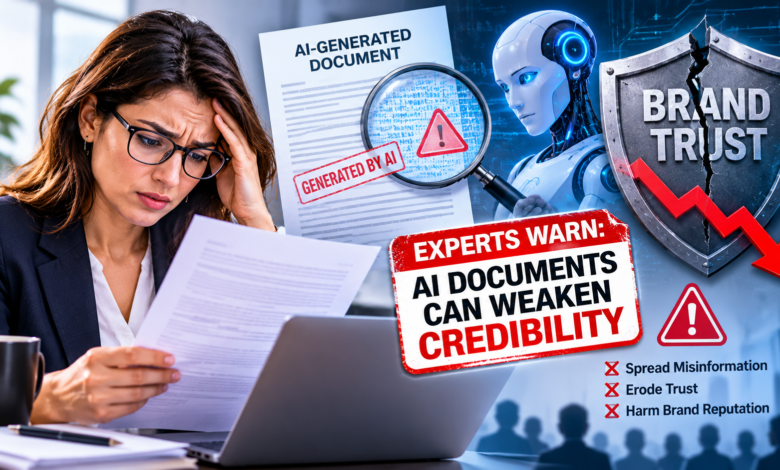
Industry experts and recent studies warn that generic AI-generated documents and “workslop” erode client trust, flatten brand voice, and waste time—plus how teams can use AI safely.
As artificial intelligence becomes a staple for drafting proposals, reports, and client presentations, communication strategists and industry analysts are warning that overreliance on unedited AI output can quietly erode brand trust and market differentiation.
According to a new analysis from Boston-based strategic narrative agency Whitepage, unchecked AI-generated documents frequently undermine credibility with clients, partners, and the public—turning what looks like a productivity shortcut into a reputational liability.
1. Brand Homogenization: Sounding Just Like Every Competitor
One of the primary risks of relying on generative AI for business communications is losing a distinctive brand voice. Whitepage pointed to a Templafy survey of 2,000 U.K. and U.S. knowledge workers who use AI for document creation, revealing that 59% of respondents believe AI-generated materials make competing organizations sound overly similar.
-
Generic Defaults: “AI tools know nothing about a brand unless someone gives it to them, so they tend to fall back on the same generic wording as everyone else,” Whitepage CEO and co-founder Tanya Slyvkin noted in the report.
-
Loss of Strategic Differentiation: Rob Enderle, president and principal analyst at the Enderle Group, warned that sounding like a generic algorithm signals a lack of original thinking. Rather than letting default AI phrasing wash out corporate identity, Enderle recommends connecting AI tools to proprietary brand style guidelines while keeping human creativity in charge.
-
Signals of Corner-Cutting: Marketing lecturer Matthew A. Gilbert of Coastal Carolina University added that sending unreviewed AI material communicates a lack of respect for clients—suggesting an organization is willing to cut corners and overlook important nuances.
SEO consultant Kasra Dash, founder of The Masterminders, summarized the client reaction bluntly: documents rarely lose credibility simply because software assisted in drafting them—they lose credibility when they read as though nobody at the company bothered to review them.
2. The Hidden Cost of “Workslop”
Whitepage also highlighted the growing workplace problem of “workslop”—AI-generated documents that appear polished and fluent on the surface, yet lack substantive insight, accurate context, or clear recommendations.
| Research Study / Source | Key Finding on AI Documents & Workslop |
| BetterUp Labs & Stanford Social Media Lab (Sept. 2025) | 40% of U.S. desk workers received workslop in the prior month; each incident took roughly two hours to untangle, costing around $186 per employee per month, while nearly half of recipients viewed the sender as less capable and reliable. |
| Seismic B2B Leadership Survey | Among 200 senior B2B leaders, 75% reported trusting human guidance more than AI-generated content when the two conflict. |
| Organizational Behavior & Human Decision Processes | Across 13 experiments, individuals who disclosed AI usage were perceived as less trustworthy than those who did not. |
Shifting the Burden Onto Readers
Strategic advisor Daniel Burrus of Burrus Research noted that workslop effectively shifts labor from the sender to the recipient—forcing clients or colleagues to decode vague statements, track down missing evidence, and clarify next steps. Similarly, SmartTech Research president Mark N. Vena described a beautifully formatted document with no real insight as an “empty suit” that creates extra work instead of delivering value.
For smaller firms in particular, Fatima Brown, founder and CEO of Reclassify AI, warned that the stakes are especially high: unlike household-name enterprises, smaller businesses cannot coast on existing brand recognition and must prove their expertise in every single client deliverable.
3. Why Commoditized Content Erodes B2B Trust
In B2B sales and executive communications, buyers quickly recognize the difference between a tailored strategic deck and mass-produced boilerplate.
-
Zero Barrier to Entry: Marty Puranik, founder and CEO of cloud provider Atlantic.Net, observed that because anyone can generate inexpensive, surface-level text in seconds, generic messaging is rapidly losing persuasive power as audiences learn to spot AI clichés and tune them out.
-
Averaging Out Creativity: A.K. Pradeep, founder of marketing technology firm Sensori.AI, pointed to a 2024 creative writing experiment showing that while AI prompts raised average individual story ratings, they also made all the stories far more alike—a reminder that optimization algorithms tend to push output toward the middle of the herd.
How to Use AI in Business Documents Without Hurting Your Brand
Experts agree that organizations do not need to abandon AI tools—they simply need clear human guardrails. Rob Enderle recommends treating generative AI like a “brilliant but inexperienced intern”: capable of outlining, structuring, and formatting quickly, but never authorized to send external work without senior human review.
Practical steps to protect credibility include:
-
Feed Proprietary Context First: Supply AI tools with your own internal research, real client examples, brand voice guidelines, and distinct point of view rather than prompting from a blank slate.
-
Eliminate Stock AI Phrasing: Edit out repetitive buzzwords and padded transitions that immediately signal automated drafting.
-
Require Named Human Sign-Off: Ensure a subject-matter expert reviews, fact-checks, and takes accountability for every client-facing proposal, email, or report before delivery.
-
Apply the “New Insight” Test: Before sending any document, verify that it teaches the reader something concrete and actionable that they did not already know.
Frequently Asked Questions
What is “workslop” in business communications?
Workslop refers to AI-generated documents, emails, or presentations that look polished and well-formatted on the surface but lack genuine substance, context, or actionable insight—forcing recipients to spend extra time deciphering or fixing the content.
How do AI-generated documents weaken brand trust?
Unedited AI documents often rely on generic phrasing that makes companies sound identical to competitors, lack tailored client context, and signal to buyers that an organization cut corners rather than applying real human expertise.
How can companies use AI for documents without losing credibility?
Teams should ground AI prompts in proprietary company data and brand style guides, strip out generic stock phrasing, and require an experienced human editor to review and approve all external documents before they are sent.